Showing posts with label Tolkien. Show all posts

Wednesday, August 6, 2025

Why the Quest Needed Frodo

In honor of Professor Tolkien's birthday, I thought it was time for another Tolkien post! (Is this going to get published on January 3rd? No, no it won't, but oh well.)

The Tolkien community online is full of thoughts, comments, and of course memes that showcase Sam's importance to the Fellowship and his strength of character. Memes like this one:


And this one:
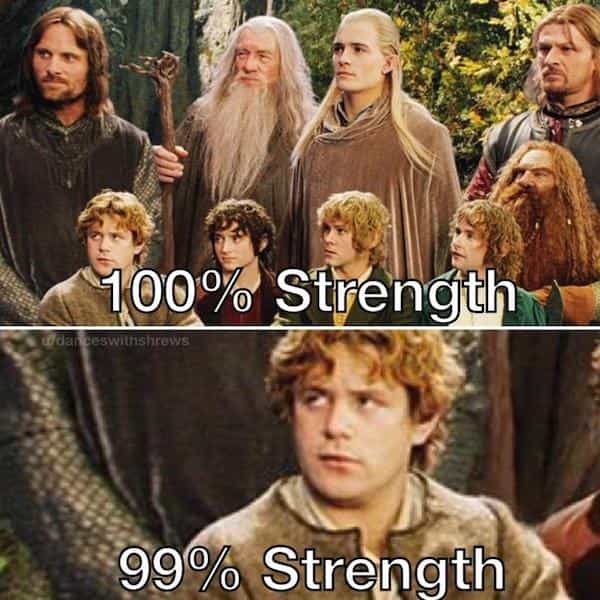
And of course, this one: 

(Okay, this isn't the one I was looking for. The one I was looking for also had Aragorn with a machine gun and Gandalf doing something. But the idea is generally the same.)

Now, far be it from me to disparage Sam himself. Sam carried a set of cast-iron cookware over mountains, past a giant spider, and into Mordor, for goodness' sake. He supported Frodo and helped him carry on when the Ring was sapping all Frodo's strength. Sam is awesome. I am, however, moderately disquieted by the way these posts praise Sam at Frodo's expense. They tend to miss the significance of Frodo's contribution in a way that fantasy, as a genre, has been missing Frodo's and Frodo-like characters' values and contributions for a long time. 

Oddly enough, the critiques of Frodo that I hear day-to-day usually have to do with him being a wimp, him whining a lot, or of him being constantly carried through his mission. However, in Tolkien's day, there seemed to be a far more serious criticism of Frodo: Frodo failed his quest. I'd never thought of this until I stumbled across this video; watching it instantly put me in mind of all the modern disdain for Frodo.

But when you recognize that Frodo failed, you recognized why the quest succeeded; and when you recognize why the quest succeeded, you can see how Frodo was absolutely a necessary part of the quest, and that Sam would have failed the quest without Frodo. 

Frodo failed because, at the very end when he stood in the center of Sauron's power, he was too weak to defy Sauron--too weak to defy the thousands-years-old demigod, the most powerful being left in Middle-earth after Morgoth was defeated. Frodo failed at the moment when everyone would have failed, because no one was powerful enough to defy Sauron in the center of his power. But then, out comes Gollum, who fights Frodo for the Ring, wins the fight, and then falls into the lava, dying but destroying the Ring. Even though the questers failed, the quest succeeded. 

But why was Gollum there? Gollum was there because Frodo spared his life and took him on as a retainer. 

Consider in The Two Towers, when Frodo and Sam have first truly met Gollum, Sam's instinct is to tie him up so he could not follow them, but Frodo remembers Gandalf telling him that Bilbo pitied Gollum and so didn't kill him; Frodo says, "But still I am afraid. And yet, as you see, I will not touch the creature. For now that I see him, I do pity him" (601). 

It's interesting to me that the book highlights how Frodo is still afraid. This mercy isn't wimpiness; it's not easy for him to show mercy. And yet, he does. 

Shortly after, when Gollum tries to escape, Sam digs out his rope and says, "You nasty, treacherous creature. It's round your neck this rope ought to go, and a tight noose too" (although when Sam tied the knot around Gollum's ankle, Frodo discovered he was gentler with the rope than with his words) (603). This theme continues; in the Dead Marshes, Sam remains untrusting of Gollum and tests him before falling asleep (609), names him "Slinker and Stinker" in his mind (624), etc. Not that Sam is proven wrong, mind you. You know how the second movie ends with Gollum deciding to lead the Hobbits to Shelob--after the Dead Marshes, after the Black Gate, after the drama with Faramir? In the books, that conversation happened much, much sooner, even before they reached the Black Gate (618-619). Sam understands Gollum well enough and is right that he cannot be trusted. But again, if Sam had his way, the Ring never would have been destroyed. 

Tolkien talks about Sam and Frodo in some of his letters to his readers, highlighting the value both of them carry in the story. In letter 184--to a man named Sam Gamgee, ironically!--he describes Sam as "a most heroic character" (not the most, but still a hero). Actually, you should read the entire letter, as it is delightful. 

Then in letter 191, he says this:

 If you re-read all the passages dealing with Frodo and the Ring, I think you will see that not only was it quite impossible for him to surrender the Ring, in act or will, especially at its point of maximum power, but that this failure was adumbrated from far back. He was honoured because he had accepted the burden voluntarily, and had then done all that was within his utmost physical and mental strength to do. He (and the Cause) were saved – by Mercy: by the supreme value and efficacy of Pity and forgiveness of injury. 

...There exists the possibility of being placed in positions beyond one's power. In which case (as I believe) salvation from ruin will depend on something apparently unconnected: the general sanctity (and humility and mercy) of the sacrificial person. I did not 'arrange' the deliverance in this case: it again follows the logic of the story. (Gollum had had his chance of repentance, and of returning generosity with love; and had fallen off the knife-edge.)

[...]

 No, Frodo 'failed'. It is possible that once the ring was destroyed he had little recollection of the last scene. But one must face the fact: the power of Evil in the world is not finally resistible by incarnate creatures, however 'good'; and the Writer of the Story is not one of us.

In this letter, Tolkien made it extremely clear that Frodo did indeed fail at Mount Doom. How could he not? Now, the mercy that Tolkien highlights in this letter is the mercy from the Writer of the Story (he doesn't say God, but I get the impression that's close enough) which is shown to Frodo: Frodo is shown mercy, even though he failed, because he had, as far as he could, poured in all his effort. Gollum's role here is shown as the logical point in which Frodo is rewarded for his prior virtues--the only way for the quest to succeed. 

In 192, he highlights some very similar details:

 It is possible for the good, even the saintly, to be subjected to a power of evil which is too great for them to overcome – in themselves. In this case the cause (not the 'hero') was triumphant, because by the exercise of pity, mercy, and forgiveness of injury, a situation was produced in which all was redressed and disaster averted. Gandalf certainly foresaw this.... But we are assured that we must be ourselves extravagantly generous, if we are to hope for the extravagant generosity which the slightest easing of, or escape from, the consequences of our own follies and errors represents. And that mercy does sometimes occur in this life. 

 Frodo deserved all honour because he spent every drop of his power of will and body, and that was just sufficient to bring him to the destined point, and no further. Few others, possibly no others of his time, would have got so far. The Other Power then took over...

To the destined point, and no further. I love that phrasing. In this letter, Tolkien is again specific that "pity, mercy, and forgiveness of injury" are the causes of success. It's not about strength, because no one's strength could possibly have prevailed against Sauron, but Frodo's mercy created a situation beyond Sauron's power to control. 

But letter 246, in addition to being the longest letter I'm quoting, has, what I think, is the most important of Tolkien's observations (emphasis mine):

 Frodo indeed 'failed' as a hero, as conceived by simple minds: he did not endure to the end; he gave in, ratted... [Simple minds] tend to forget that strange element in the World that we call Pity or Mercy, which is also an absolute requirement in moral judgement...

 I do not think that Frodo's was a moral failure. At the last moment the pressure of the Ring would reach its maximum – impossible, I should have said, for any one to resist, certainly after long possession, months of increasing torment, and when starved and exhausted. Frodo had done what he could and spent himself completely (as an instrument of Providence) and had produced a situation in which the object of his quest could be achieved. His humility (with which he began) and his sufferings were justly rewarded by the highest honour; and his exercise of patience and mercy towards Gollum gained him Mercy: his failure was redressed.

What I find interesting about this letter is that Gollum is no longer just an incident which logically leads to the Ring being destroyed, but rather his appearance at Mount Doom is a direct reward for Frodo's mercy toward Gollum. Moving on, from the same letter (again, emphasis mine):

 Sam was cocksure, and deep down a little conceited; but his conceit had been transformed by his devotion to Frodo. He did not think of himself as heroic or even brave, or in any way admirable– except in his service and loyalty to his master. That had an ingredient (probably inevitable) of pride and possessiveness: it is difficult to exclude it from the devotion of those who perform such service. In any case it prevented him from fully understanding the master that he loved, and from following him in his gradual education to the nobility of service to the unlovable and of perception of damaged good in the corrupt. He plainly did not fully understand Frodo's motives or his distress in the incident of the Forbidden Pool. If he had understood better what was going on between Frodo and Gollum, things might have turned out differently in the end. For me perhaps the most tragic moment in the Tale comes in II 323 ff. when Sam fails to note the complete change in Gollum's tone and aspect. 'Nothing, nothing', said Gollum softly. 'Nice master!'. His repentance is blighted and all Frodo's pity is (in a sense*) wasted. Shelob's lair became inevitable. 

 This is due of course to the 'logic of the story'. Sam could hardly have acted differently. (He did reach the point of pity at last (III 221-222)4 but for the good of Gollum too late.) If he had, what could then have happened?... I think he would then have sacrificed himself for Frodo's sake and have voluntarily cast himself into the fiery abyss.

The rest of the letter deals with how other characters would have used the Ring to defy Sauron, and it's actually quite interesting, so I encourage you to read that, also. 

But all of this excerpt shows why the Ringbearer had to be Frodo: he was the one who best understood the concept of mercy in a way Sam didn't grasp. Partly thanks to the example set by Bilbo in The Hobbit, and partly thanks to Gandalf's mentorship in Fellowship of the Ring, Frodo is the one who committed the action that made the quest succeed--long before he reached Mount Doom. Tolkien expressly criticizes Sam's harsh judgment, even though he recognizes Sam's courage in letter 184, and specifically points out that it endangered the quest rather than protecting it. 

It absolutely fascinates me that the action critical to success in Tolkien's great epic is mercy and forgiveness, and I'm moderately irritated with myself for not recognizing it sooner. It's super easy to get lost in the general epicness of Aragorn, Boromir and Faramir, the Rohirrim, the constant fighting, the mumakil and the Nazgul, and so on. But ultimately, none of that would have been worth anything if Frodo's quest had failed, and Frodo's quest would have failed without that act of mercy. 

And yes, I started writing this on January 3rd and finished it on August 6th. Go figure. 

Wednesday, June 25, 2025

Characters Who Were Told to Stay Behind

 Maybe as I'm writing this post, a point will come to me. At the moment, I have no real point to writing this, but I have a blog, I have time now that it's summer, and this just occurred to me and I found it interesting. So here we go! 

In my post about War of the Rohirrim, I made a small section about how Eowyn was ordered to return to Edoras and lead her people, even though she didn't want to. I don't know what prompted this thought, but it suddenly dawned on me that a character in the Chronicles of Narnia had much the same choice and command: Prince Caspian, in Voyage of the Dawn Treader (my second favorite of the books). 

For comparison sake, here's the book exchange between Eowyn and Aragorn (I couldn't find an exchange like this between Eowyn and Theoden):

"Lord," she said, "if you must go, then let me ride in your following. For I am weary of skulking in the hills, and wish to face peril in battle."

"Your duty is with your people," he answered. 

"Too often I have heard of duty," she cried. "But am I not of the House of Eorl, a shieldmaiden and not a dry-nurse? I have waited on faltering feet long enough. Since they falter no longer, it seems, may I not now spend my life as I will?"

"Few may do that with honour," he answered. "But as for you, lady: did you not accept the charge to govern the people until their lord's return? If you had not been chosen, then some marshal or captain would have been set in the same place, and he could not ride away from his charge, were he weary of it or no."

"Shall I always be chosen?" she said bitterly. "Shall I always be left behind when the Riders depart, to mind the house while they win renown, and find food and beds when they return?" (Return of the King, 766-767). 

She does go on to say that she's only being left behind because she's a woman, but that's a topic this post isn't about. 

Here is the exchange with Caspian:

"Friends," said Caspian, "we have now fulfilled the quest on which you all embarked... To you, my Lord Drinian, I entrust this ship, bidding you sail to Narnia with all the speed you may... it is my will that the Regent, and Master Cornelius, and Trufflehunter the Badger, and the Lord Drinian choose a king of Narnia with the consent--"

"But, Sire," interrupted Drinian, "are you abdicating?"

"I am going with Reepicheep to see the World's End," said Caspian. 

A low murmur of dismay ran through the sailors.... 

"Caspian," said Edmund suddenly and sternly, "you can't do this."

"Most certainly," said Reepicheep, "his Majesty cannot."

"No indeed," said Drinian. 

"Can't?" said Caspian sharply, looking for a moment not unlike his uncle Miraz.

"Begging your Majesty's pardon," said Rynelf from the deck below, "but if one of us did the same, it would be called deserting."

"You presume too much on your long service, Rynelf," said Caspian. 

"No Sire! He's perfectly right," said Drinian.

"By the Mane of Aslan," said Caspian, "I had thought you were all my subjects here, not my schoolmasters."

"I'm not," said Edmund, "and I say you can not do this."

"Can't again," said Caspian. "What do you mean?"

"If it please your Majesty, we mean shall not," said Reepicheep with a very low bow. "You are the King of Narnia. You break faith with all your subjects, and especially with Trumpkin, if you do not return..." (Voyage of the Dawn Treader, 259-261). 

Caspian then loses his temper and storms into his cabin, but Aslan comes and tells him that he needs to return to Narnia. He has a sad parting with Lucy and Edmund, but he does return, marry the love of his life, and... everything after is explained in The Silver Chair (my favorite of the Narnia books). 

The most obvious shared theme between the two of these is a ruler's promises to their people. Eowyn accepted the charge of ruling, so she must keep her word; Caspian had built faith with his subjects and his friend Trumpkin the dwarf that he would be breaking if he abandoned Narnia. Furthermore, both of these exchanges have someone compare the leader to a lower-ranking person. Aragorn tells Eowyn that a captain or a marshal couldn't just leave even if he wanted to, meaning that neither can she. Rynelf the sailor has the temerity to tell his king to live by the same standards that he expects from his sailors.

Of course, if you read the books or watch the movies, you'll know the biggest difference between the two: Caspian does what he is told, while Eowyn disguises herself and joins the Rohirrim in their attack at Minas Tirith. I think another difference that appears in the exchanges are the emotions behind their desire to leave their post. I tried to look back and find Caspian's reasons for wanting to go beyond the end of the world, and I couldn't really find anything specific; but it seems implied that he wants the adventure. It comes across as hopeful, looking forward to something. Eowyn, in sharp contrast, is filled with despair. It's not super clear in that particular exchange, but later on, when Aragorn is healing Eowyn, Gandalf says this to Eomer:

"Think you that Wormtongue had poison only for Theoden's ears? Dotard! What is the House of Eorl but a thatched barn where brigands drink in the reek, and their brats roll on the floor among their dogs? Have you not heard those words before? Saruman spoke them, the teacher of Wormtongue. Though I do not doubt Wormtongue at home wrapped their meaning in terms more cunning. My lord, if your sister's love for you, and her will still bent to her duty, had not restrained her lips, you might have heard even such things as these escape them. But who knows what she spoke to the darkness, alone, in the bitter watches of the night, when all her life seemed shrinking, and the walls of her bower closing in about her, a hutch to trammel some wild thing in?" (849).

Eowyn--partly under the powerful influence of Wormtongue--had given up on her country and her kindred. The only thing she really had to look forward to, or so she thought, was dying honorably with them in battle. She was running away from something, not running toward something as Caspian seems to be. 

Ultimately, of course, both characters end up with a happy ending. Eowyn marries Faramir and lives in peace with him in Ithilien. Caspian... well, The Silver Chair is largely about Caspian's great griefs, but if you read that book, you'll know he had a happy ending, too. 

And no, no point has really come to me as I was writing this. But it remains interesting to me, to think about two wildly different characters in completely different books that were faced with such a similar choice. 

Sunday, May 4, 2025

I Rather Enjoyed War of the Rohirrim

 Maybe it's because I had very low expectations, maybe it's because the nostalgia factor is strong, or maybe it's just that the characters were endearing and the movie practically rained love and pride, but I actually enjoyed watching the movie. Oh, it's not as good as the original trilogy, and it's certainly not above criticism, and some of the dialogue was only shallowly connected to each other, but it was still a decent and enjoyable project. 

Now, if when you think of Tolkien you expect more than "decent", I sympathize. If you heard about a story set during the life of Helm Hammerhand and wanted to actually see his story, not just hear his story in voiceover, I sympathize. If you have a hard time getting on board with the anime logic, I deeply sympathize. If you don't like it because you don't think Tolkien would like it--well, he probably wouldn't. (But then, I don't think he would have liked the Jackson trilogy, and I love that, so, sorry.) 

I want to make it clear: I went in expecting to hate it. I was ready to roll my eyes, groan, facepalm, all that. Instead, I had a great time! I think the last time my expectations were this subverted, it was by Frozen. 

I should mention that I haven't listened to or read any of the reviews about it yet. I have seen plenty of headlines (couldn't avoid them), and they discouraged me from paying to see it in theaters, but I don't actually know what other people don't like about. I can guess. I can really, really guess. I can easily guess. But I don't know. I know what I found questionable, but I also know that I really enjoyed some of the movie. 

The one thing I will say without a shred of regret, is that anybody who said it was worse than The Hobbit, I don't agree. It's better than the Hobbit movies. It's so much better than the Hobbit movies. 


What I expected to be the main problem with the movie (but wasn't)

I expected this movie to be like mixing bacon and ice cream: mixing Tolkien with classic anime. One of these things is not like the other, and I predicted that would be a problem. Classic anime tends to have ridiculous events, and then deeply analyzes characters psychology based on those wild events. Tolkien doesn't really analyze psychology, not really. He acknowledges it in certain characters, of course--Bilbo, Frodo, Boromir, and Eowyn all come to mind--and he's clearly aware of psychological effects, but he doesn't lay them all out in the same way most anime I've watched does. Rarely do his analyses go beyond establishing character motivations. 

Then there is the fact that Tolkien relies on the literary traditions of Anglo Saxon, Finnish, and Germanic epic poetry, while anime... I assume relies on Japanese tradition? I mean, I don't think it relies on the same traditions that Tolkien does? If it does, someone let me know, but I certainly haven't recognized that tradition in the animes that I've seen. 

But I will concede that there are some moments in Tolkien's legendarium that fit with the physics-defying logic of anime action. I've heard some people talking about having an anime portrayal of the battle between Morgoth and Fingolfin in Silmarillion, but the story of a king who tears most of an army apart with his bare hands and dies upright because he's frozen solid... yeah, that fits with anime physics. 

The movie definitely knew when to apply anime logic and when not to. The action scenes--where you see hand-to-hand combat--are very anime. Fine--they looked pretty good. 

As I'm writing this, I'm realizing that the scenes of fighting on horseback were rather abbreviated. I don't remember anime having great horse fighting, so maybe that's another sign of anime accommodation. But obviously, we're talking about the Rohirrim. Kinda important to get the horse animation correct there, guys. 

What I think is the main issue most people have with the movie

I think everyone is sick of shallow characters--that is to say, characters who are strong at the expense of other key characters.

The very obvious example of this is what the Harry Potter movies did to Hermione. I've mentioned before that they gave one of book-Ron's greatest lines to Hermione in the third movie, but Ron was done a horrible disservice throughout the series while Hermione was significantly buffed up. Then, of course, the was the most recent nonsense that Prime churned out where Miriel was given... well, given almost-warrior status and Pharazon never did anything with a weapon, whereas in the book Pharazon was clearly a great warrior, while Elendil's noble lineage was stripped away so he could be nervous in front of her. Miriel's character was blank, so the showrunners wouldn't have been unjustified in inventing a lot, but they couldn't do that without stripping away the key characteristics of the characters around Miriel. 

There's another moment from the Harry Potter movies that I haven't seen other people talk much about, but that really annoys me, and that is the scene on the stairs between McGonagall and Umbridge in the fifth movie. They're quarreling and it ends with McGonagall backing off in stunned silence, and Umbridge stepping up a few more stairs to lecture the entire hall. Yeah, McGonagall in the books would never have done that. In chapter 15, when she's being inspected, she shuts Umbridge up with a couple of lines, and then in chapter 29 when she's giving Harry advice on how to become an Auror in direct defiance of Umbridge's simpering, she calls Umbridge incompetent to her face and straight up yells at her. But I guess the movie people were afraid people wouldn't be scared enough of Umbridge without making McGonagall seem weaker than her--making Umbridge strong at the expense of McGonagall.

I think this is what people were expecting: they were expecting Hera to be strong at the expense of Helm. That, however, is not what happened. 

How the story is really told

When I heard that Hera was going to be the main character, not Helm, I fully expected the movie to make her more important to Rohan's survival than Helm. I hesitantly suspect this might be an anime vs. western storytelling thing: in most western storytelling, the main character is almost always the most important/powerful/pivotal... whatever character. Harry is the Chosen One in Harry Potter, Matthias is the main character in Redwall, Mrs. Brisby is the main character in The Rats of NIMH, etc. So, when it was announced that Hera was the main character, I think everyone expected her to supplant Helm as the pivotal character. 

I think it is... slightly more common for anime to have a story where the main character is not the pivotal character. The story is more about watching the pivotal character through the eyes of the main character. But the problem I have is that I don't actually watch that much anime, and the ones that come to mind when I think about them are not ones I want to reference in my blog. So...

The best comparison I can come up with is The Legend of Luke. At least for the first third, the main character is the one hedgehog girl... it's not Tansy, she's in Pearls of Lutra, but I can't remember the right character's name just now... but the pivotal character is still Martin the Warrior. The story of Martin is told through Tansy's eyes. 

War of the Rohirrim is the story of Rohan told through Hera's eyes. That's what makes her the main character. That's a little unusual in our stories, and it's certainly unusual for Tolkien, but that is ultimately what happened. 

Actually, now that I think about it, both the major battles were spread out, far-flung, and complex, and there were different pivotal points; in both battles, Hera is at one pivotal point, while others hold different pivotal points. What sets Hera apart is that she is the character we see the story through.

The characters are wonderful

There are a lot of characters in such a short movie, but what's amazing is that all of them quickly establish their own endearing or repulsive personalities in very short order. Hera, her father, her maidservant, her guard, her two brothers, her cousin, the main villain, and secondary villains are all immediately set apart from each other by visual clues, dialogue, and storytelling all within a few seconds of screentime. Very little of that establishment is set up by narration or direct exposition. It's seen, not shown. It also feels natural to the story. 

One of the characters (the younger brother) is clearly different from how Tolkien briefly described him; the villain has an additional motive tacked on; but honestly, I don't think any of those changes are worse than what the movies did to Faramir. (Yes, I know what the trilogy did to Faramir, and I still love the movies.)

This movie shows why Eowyn's actions in Return of the King could have been catastrophic

In Return of the King--I'm going off the movie, not the books--Theoden ordered Eowyn to return to Edoras and rule it, not ride to war with her people. Eowyn instead disguises herself and rides to Minas Tirith. Her motives are born of courage, love for her people, love for her brother and her uncle, which is why she's able to slay the Witch-king (that's even clearer in the book). Ultimately, this was important for the battle, and a great scene... but it left Edoras without a proper ruler. 

Hera faces a very similar situation in this story, but she instead obeys her father's order to stay in Edoras and rule. Because she's in Edoras, because of where she is, she realizes that something has gone horribly wrong and Edoras and the noncombatants are all in terrible danger, and she promptly evacuates them. If she hadn't been there, what would have happened to the people? 

Now, the obvious answer to some of us is, "Well, just have the king appoint someone else", but I think it's important to remember in Tolkien's world that royal bloodlines have gravitas they just don't have in modern America. There's a great scene in the Two Towers book when Theoden is about to leave for Helm's Deep and he asks the people who they want to lead them, and the general consensus is they want Eowyn as their leader because she's from the royal bloodline--they'd rather have a royal woman leader than a nonroyal man leader. That's why it's important that Hera did what she did. 

But seriously, who is this movie made for?

I've been puzzling over this question, and I think I have the answer: the movie is made for people who found Tolkien through the Jackson trilogy and were inspired to dive deeper into the books because of the movies. Not for people who already loved the books before the trilogy, and not for people who loved the movies but didn't dive any deeper; people who specifically nerded out on the books because of the movies. 

You know. People like me. I am this movie's target audience.

The biggest thing that I think a viewer needs to understand in order to appreciate this movie is Anglo-Saxon culture. Within the first few minutes, there's a repurposing of an old Anglo-Saxon poem; it was the inspiration for one of Theoden's lines in the book, and it's the inspiration for some of the music in this movie too. Then there's the issue of one of the secondary villains, and why he's staying with his lord even though he profoundly disagrees with him--because he swore an oath, and oaths to lords are sacred. The movie doesn't actually explain that, which is a bit of an issue for understanding what's going on. 

It pulls the rug out from under Rings on Prime, and I love that 

You cannot convince me that the scene of Hera climbing the mountain behind Helm's Deep isn't making fun of that Main Character climbing scene in the first episode. 

Oh, and then there was the ending, when Hera rides off to meet with someone who's very interested in a conversation she overheard between two orcs looking for a ring... her maidservant asks what his name is, and she says he has a lot of names but he wrote to her as Gandalf. Aaaaand, there's the entire subplot of Rings season 2 in two lines of dialogue. The best part is that this dialogue had to have been written before Rings season 2, so they weren't deliberately making fun of it--they were just doing the same thing, but much better. 

It's a great time

I think my favorite part was probably when the mumakil was afraid of fire. That came from the old Battle for Middle-earth computer game, which I love dearly. It was a great bit of nostalgia, but I think it's also one of several examples that shows these moviemakers like their fans. 

The characters are great, and the goodwill between them makes the movie even better. I heard someone say that Hera was a self-insert character for Philippa Boyens, but if so, it wasn't obvious to me. 

Some of the dialogue was clunky, some of the animation was strange, and there were definitely a few points where Hera got some praise she didn't earn. 

But overall, it was beautiful, it was a passion-project, and it was loveable. I really enjoyed it--although, I like I said, I'm definitely this movie's target audience. So check it out at least once, and if you don't like it, well, it's about a third of the length of one of the Hobbit movies, so what have you really lost?

Sunday, June 23, 2024

I Apparently Live in Mordor

 At least, I do according to Rings on Prime. 

Trying to figure out distances in the Rings on Prime's maps is almost as bad as trying to figure out distances in my books. (Oh believe me, I know, but my excuse is I was a teenager when I planned them and I didn't have tens of millions of dollars to hire expert cartographers!) But according to Microsoft Copilot, and yes, that is the best source I have for this:

The distance between Ostirith and Mount Doom in Middle-earth varies depending on the map used, but it’s roughly 100 miles or 160 kilometers. The Tower of Ostirith, perched high on a cliff, overlooks the settlements of Tirharad and Hordern12. Mount Doom, also known as Orodruin, stands alone in the Plateau of Gorgoroth, rising about 4500 feet with its base approximately 3000 feet tall3. So, while the eruption of Mount Doom would indeed be powerful, the Southlands should be well within a survivable distance from it. Remember, though, this is all in the magical realm of fantasy! 🌋🔥1.

So, 100 miles? It was 100 miles from that water-started pyroclastic flow to the Elven watchtower?

According to Rings on Prime, water kickstarted a pyroclastic flow from Mount Doom that devastated the entirety of Mordor, including the watchtower a hundred miles away and other lands even further, and that explained why the land was ruined for thousands of years. This is the point--the pyroclastic flow from Mount Doom is supposed to be so strong that it blocks out the sun so the orcs can walk around without being burned by the sun. 

I know very little science, but I know this is silly because of where I live. 

My apartment is about 120 miles driving distance and 44 years away from Mt. St. Helens. So, according to the show's logic, I should be living in Mordor in an ecosystem the orcs would be happy with. 

I don't. Because that's not how volcanoes work. 

By the way, I have heard tell (although I can't find a written source to corroborate) that St. Helens was a vent for multiple volcanoes all around the Ring of Fire, and that it relieved pressure of multiple volcanoes. Therefore, one would think its eruption more powerful than the eruption of a single volcano that isn't part of a range. 

Also by the way, I remember hearing from a very young age that the truly dangerous part of a volcanic eruption like St. Helens was not the pyroclastic flow, although that was deadly, but rather the mudflow, when all the glaciers on the mountain suddenly melted and the water mingled with ash and dirt to slide down the mountain at incredible speeds and sweep away anyone and anything in its path. Like, I remember, in first grade, the teacher reading to us a picturebook about St. Helens during reading time, and someone asking if all of this one guy's sixteen cats died in the mudflow.

Look, I realize this is shoddy reference work, but that's because I'm referencing the lore and legend of my home. My mom and grandparents lived in Washington during the eruptions. Mom scraped a bunch of St. Helens ash off of her car in a peanut butter jar, and I think she still has it somewhere. I have three figurines carved out of St. Helens rock sitting on my shelf. I don't remember a single year in elementary school when I didn't have at least one lesson about St. Helens. In sixth grade, the much-hyped overnight field trip was visiting St. Helens. I remember, with vivid clarity, my fifth grade teacher telling how when the mountain erupted, she filled her bathtub with water to make sure she had fresh water, sat holding her child wondering if she was going to watch her family die horrible deaths, and then hearing God promising His strength to her if it came to that. 

And now I live in places where they all lived, in green, flourishing, beautiful lands that look more like the Shire than like Mordor. So I don't have to have a degree in science to know how stupid this is. 

This was St. Helens in 2018, a few months before I went to China. 

In the books, Mount Doom was not a natural volcano; instead, its eruptions were directly connected to what Sauron was doing. But if you had the misfortune of watching Rings on Prime, you may have noticed that Mount Doom went off because some water spilled onto the magma which caused a pyroclastic flow--meaning that they tried to make this make sense with science (by the way, read that entire article, because that headline is not what the scientist said! He describes exactly what kind of eruption happens, and nowhere does he mention a pyroclastic flow!). 

And before you (and by "you", I don't mean my average reader, I mean whoever at Amazon may be reading my blog) say that the water only started the volcano but Sauron's power can continue the volcano, maybe, but the point of the volcano in Rings on Prime was to create a new homeland for the orcs--a place they can call their own and not have to worry about the sun. That kind of implies the characters thought the water on the magma would continue an eruption for the foreseeable future, doesn't it? 

It feels weird to write this post because of how limited my scientific knowledge of volcanoes truly is. But in the end, none of my favorite reviewers mentioned Mt. St. Helens compared to Mount Doom, so I decided it was worth the post. 

Wednesday, May 15, 2024

Darkness Will Bind Them?

 English lesson! 


In that poem, there are four verbs: "rule", "find", "bring", and "bind". A verb must be done by a noun; so, dear reader, which noun is doing those verbs? Is it

a) One Ring, 

b) Darkness, or

c), Them? 

Well, according to Rings on Prime, the answer is "Darkness":


The real answer, of course, is a), the One Ring. The One Ring will bind the other rings in darkness. 

Seriously... did an AI create this trailer? 

By the way, if my add-on is to be believed, yes, that trailer is approaching a 1:5 like-to-dislike ratio. 

Tuesday, May 14, 2024

Is Someone At Amazon Reading My Blog?

 Like everyone else on Twitter, I knew that Rings on Prime's second season's trailer would drop today. I have watched the thing, and of course I have thoughts, but the thing that stood out the most to me was this one shot of The Main Character:


Does this mean somebody at Amazon was reading my previous posts about her hair not being in a crown?!

Probably not, but just in case some person is, in fact, reading my blog, here's the one thing I want to say to you the most: stop messing with stuff. Stop giving Pharazon's character traits to Miriel. Stop inventing characters if you can't include the already-existing ones (hey, was Anarion even in that trailer? He wasn't in the first season. What about Cirdan the Shipwright? I'm pretty sure they promised us Cirdan). Stop giving new powers to the Silmarils, as if they weren't already epic enough. 

We love Tolkien as his works are. You want to win an audience back? Stop messing with Tolkien to the point that your show is unrecognizable as Tolkien's works. 

Tuesday, April 2, 2024

If This Is Lore, It's Bad Lore

I think I've read somewhere that the two Rings on Prime showrunners really know their Middle-earth lore. Every once in a while, something flashes through in the show that supports this claim; the problem is that the lore is used so badly that it makes no sense. In addition to the rough and pointless explanation of the Silmarils and the invention of an elf fighting a Balrog on the Misty Mountains instead of near Gondolin, there was something else that gave me pause.

I'm not saying it's unreasonable, per se, but in the context of the show...

To set the scene, The Main Character is in an elven graveyard, looking at the images of dead elves carved into living trees. The scene flashes by a few dead elves, and this one grave caught my eye:


At no point does the show give a name for this dead elf, but upon my first viewing, I saw this glimpse and immediately thought, I know who that is! In the Silmarillion, there is one infamous elf-dog duo, and I can't think of another one. 

Then I decided that my knee-jerk reaction might be wrong, so I did some digging just to verify. 

What do we have in the picture? An elf that we know is dead and a big shaggy dog. That star on his shoulder is worn by all the elves in this show, and I remember fans arguing over whether that was the star of Feanor or the star of Finarfin (this article explains why it's really neither). One of Feanor's sons was Celegorm, and because he was a renowned hunter, the Valar Orome gave him a mighty hound dog named Huan. 

That dog in the picture first gave me pause, because that is not a hound dog. My brother has a hound-shepherd mix, and she has short hair and enormous eyes, which is about the opposite of that dog. Then I remembered that while Huan is called Huan the Hound, he's actually a wolfhound, not a hound... and a wolfhound looks pretty much like that carving! He's also too small to be Huan--if you've ever seen the Silmarillion cover that has the woman riding on the dog, that's Huan:

Image source, ironically, from Amazon.

Regardless, I think it's reasonable to assume this grave is Celegorm and Huan, yes? If it's not, and the show just invented another wolfhound-elf duo purely to be in a tomb, then I don't think that's my fault for guessing wrong. 

Having said all that... why was Celegorm buried with honor when he was so evil that Huan abandoned him? 

Most of Feanor's family had severe moral shortcomings, but a serious argument can be made for Celegorm being the worst of them. His primary role involved manipulating the people of Nargothrond (the city of Finrod, Galadriel's beloved brother) away from their true king (which was Finrod); lying to Luthien and then imprisoning her to force her to marry him; and then egging on his brothers to the Second Kinslaying (where he died fighting Luthien's son). 

Hang on, hang on, hang on... the show wants me to believe that The Main Character is Galadriel. The Main Character--in that very scene the screenshot is taken from--is mourning her brother Finrod. Celegorm undermined Finrod and tried to take his city and his people from him. Why, why, is he buried next to Finrod? Why would The Main Character allow that? 

I could be wrong (I don't have the book with me at this moment), but... but didn't Celegorm specifically mean for Finrod to die in Sauron's dungeons? As much as The Main Character hates Sauron for murdering her brother, shouldn't she also despise Celegorm for abandoning her brother to die? And yet, here we have his statue next to Finrod's, and even a line about how The Main Character thought she'd be buried next to all the dead elves there, including Celegorm? 

By the by, after it was revealed that Celegorm and one of Feanor's other sons had lied to Luthien and... possibly abandoned Finrod to die, on purpose? I can't remember... the people of Nargothrond turned them out, and even Celegorm's nephew was so disgusted that he refused to go along with him. That nephew was Celebrimbor, also a character in the show. 

Furthermore, in that second Kinslaying, Celegorm's servants captured Luthien's grandsons and deliberately abandoned them to die in the forest. Maedhros and Maglor, two of Feanor's less objectionable sons, heard about this and were horrified, so they searched for the two boys but never found them. I... won't say that's as severe a rejection as Celebrimbor's, but that's certainly not an honorable memory. 

All of this is to say that it makes no sense for these two to be memorialized next to each other, and given how soundly Celegorm was rejected by even the other Noldor, I don't know who would have built his memorial in the Noldor capital. 

It also makes no sense for Huan to be memorialized with Celegorm, because he abandoned Celegorm and devoted himself to Beren and Luthien instead. 

It is not impossible for Gil-galad to have built this as some peace memorial between the elves, or for some other powerful Noldor lord to want to honor both of them, or for someone to have decided that every Noldor who fought against Morgoth should be honored, and that that was more important than any of their infighting. All of this is possible. I would love for that to have been explained. 

But really, what was the point? What was the point of hinting at Celegorm and Huan, but doing it so perfunctorily and badly? 

Saturday, January 20, 2024

Evil Races? Let's Look At Two Fantasy Examples

This post does not have a point. It's just a series of my observations. 

One of the key points of Rings on Prime was their attempt to humanize the orcs, which is interesting because Tolkien himself also struggled with the idea of having an intrinsically evil race, like orcs. This video, from about 14:10-14:45 or so, does a great job explaining why RoP failed. 

I've heard things (but it's 10 PM at night and I have work tomorrow, so I'm not researching them now) about Tolkien having a hard time reconciling an "evil race" like orcs with his values of redemption. I've also read a lot of headlines about Tolkien's creation of an evil race being racist and problematic and so on and so forth. I remember also hearing about evil races being reevaluated in other forms of fantasy media, such as D&D--hence this song, for example. 

Something I realized recently, though, is that there is another "evil race" in fantasy that I have never heard this kind of theorizing about: the dementors from Harry Potter. Dear reader, I wonder why this might be? Why are fantasy readers uncomfortable with the orcs being an "evil race", but not uncomfortable with the dementors? 

I mean, I haven’t seen any D&D stuff rewriting the dementors to be sympathetic characters who have their own perspective, and NO, that is NOT A SUGGESTION. Please don’t do that! Having the unsympathetic villain makes the story more interesting, and when the characters spend the entire third book wondering about the morals of compromising with something so evil because it’s a way to punish other evil people… I mean, that’s very interesting and thought-provoking. (Especially when it turns out that they had no compunctions about punishing innocent people, because they are unrestrained evil.)

But I do have to wonder, why are intrinsically evil characters not even noticed in one series, but make lots of other people (including the writer) uncomfortable in a different series?

I suppose one possibility is the context of the story. Rowling’s books have a lot of discussion about unfair treatment to other creatures, so when she trots out one irredeemable creature, everyone kind of gives it a pass. 

Perhaps also because the only things we ever see dementors do are things that humans can’t do, and therefore we have no investment in them being redeemed. Orcs, on the other hand, engage in cruelty and violence, things that humans do and can be redeemed from, so we have an investment in their redemption.

However, I think the biggest difference is that the dementors are clearly some kind of animal, but the orcs in Tolkien were once other creatures. (The movies say they were once elves who were tortured and corrupted, and Rings on Prime really leaned into that; I’ve heard somewhere that Tolkien changed their backstory into something else, but I don’t remember what it was, and that’s not the one that everyone’s thinking of anyway, so…) Orcs are on one level the Elves are on too, while dementors are more in the category of wolves, sharks, and other animals that haunt our nightmares… except that the dementors in the book clearly talk to humans, so theoretically they should be on the same level as humans. 

To be honest, I don’t really care. There are other creatures in Tolkien’ legendarium that no one feels the need to redeem (Balrogs, barrow-wights, and Nazgûl all come to mind), so maybe I’m wasting my time wondering over this question. But I thought it was an interesting difference, and I haven’t posted in a while, so there it is. If anyone has thoughts, then the comments should be working!

Wednesday, November 22, 2023

Eight Things Rings on Prime Absolutely Did Not Do Better Than Peter Jackson

 I'm not the biggest fan of Screen Rant, mostly because they have interesting headlines that I click on before realizing it's another article from them and that now my Facebook feed will be full of their far-less interesting articles. But I saw this article and I simply couldn't resist clicking on it, because yikes: "8 Things The Rings Of Power Does Better Than Peter Jackson’s Lord Of The Rings Movies".

Full disclosure, I saw the Jackson trilogy before I read the books, so I'm rather biased in favor of Jackson. Nonetheless, let's take a look at their list. I'm going to deal with their subheadings, not all their details unless their details are important. 

8. Rings Of Power Makes Sauron A More Interesting Character:

Sauron Was An Unseen Villain In Jackson's Lord Of The Rings

Sauron was an "unseen villain" in the trilogy? We saw his eye all the time (and yes, I know that the "eye" wasn't described that way in the books), and we heard his voice, which was freaky! If anything, that "eye" means we saw him more in the movies than we did in the actual books! (In fact... do we ever "see" him in the books?) He wasn't supposed to be the "interesting" villain; that was more Saruman, Denethor, and Wormtongue, who were admittedly a little shortchanged in Jackson's trilogies. 

But the point of the article isn't Jackson's imperfections; it's Payne and McKay's supposed areas of superiority over Jackson. The problem is that Payne and McKay's Sauron isn't interesting; he's just confusing. They don't establish his motivations until much too late, and although they suggest going back and rewatching the show now that you know Halbrand is Sauron (hahaha, now that you know, as if everyone didn't instantly know), it doesn't clarify any of his motivations. Confusing is not the same as interesting. 

This is the part that really annoyed me, though:

Tolkien's various notes and unfinished stories, collected and posthumously published as The Silmarillion and other books, provided even further details about Sauron, including his multiple plans, forms, and general personality. Prime Video's The Rings of Power really works in that it brings these aspects to the screen. Halbrand may be an invention of the series, but he better reflects who Sauron was.

It does not work. It absolutely does not work. The appendices say that Sauron "endeavours to seduce the Eldar. Gil-galad refuses to treat with him; but the smiths of Eregion are won over" in the year SA 1200, and three hundred years later, "The Elven-smiths instructed by Sauron reach the height of their skill. they begin forging the Rings of Power" (364, Return of the King, 1978 edition). They take roughly 100 years to finish, and only after Sauron forges the One Ring does Celebrimbor realize Sauron's real plans. That's about 400 years of planning, plotting, deceiving, and so on. In the show? He steals some things, he says a few diplomatic lines... and the only reason they're seen as clever or manipulative is because The Main Character is so utterly demanding and tactless. The last episode has him suggesting stuff to Celebrimbor that Celebrimbor should already know only to have another metaphor, but that takes up only part of the episode. And that, to Screen Rant, is "working"? Condensing 400 years of plotting and scheming into a few dumb lines that are primarily metaphor and some theft is somehow better than Peter Jackson's Great Eye? Better? 

In the last scene between Sauron and The Main Character, he lays out how she has been controlling events, and not him. You think that's closer to Sauron's character? 

That's just different. That's not better.

7 Peter Jackson's Lord Of The Rings Changed Elrond:

Elrond Is Far Kinder & Less Critical In Rings Of Power

I think this is the most reasonable one on the list, but it's once again different, not better. I quibble with the idea of describing Elrond as a "politician", when he should have been called a "herald" or a "captain"... oh wait, are they trying to make it "accessible" to "modern audiences"?  And to be fair, Robert Aramayo was an excellent choice to play Elrond (and I sincerely hope he quits Rings on Prime and goes to HBO's Harry Potter series and plays Lupin. He's just the right age, he's clearly a subtle actor, and he sure looks like Lupin!) Elrond's script tended to make the most sense, he was the least likely to describe what we could see happening on screen anyway. Like Sauron, his motivations weren't always clear, but they sure make more sense than Sauron's do. 

But none of that makes him better than Jackson's Elrond. I know Elrond never opposed Arwen's marriage to Aragorn in the book, which is a noticeable change. On the other hand, the Elrond in Rings on Prime agreed to "treat" with Sauron in the show, which he clearly didn't do in the lore. None of the Elves who were corrupted by him knew that he was Sauron at first, either, similar to the show, but certain Elves still sensed and mistrusted him because of their perceptiveness--Elrond in particular. So, which change is worse? The one where he loves his daughter so much he needs to be persuaded extra hard to allow her to marry a mortal? Or the one where he loses his perceptiveness and--possibly--some of his virtue and his rejection of power's temptations? 

To be honest, the Elrond in the show seems to want power--not necessarily for himself, but for the people around him. He first goes to the Dwarves because he wants to help Celebrimbor build the most powerful forge ever in order to recreate the wonders of Feanor (because the Silmarillion's whole plotline totally isn't a warning sign for how terrible an idea that is, oh no), and not to go revisit his friend. 

I'm with Jackson on this one, not McKay and Payne. 

6. Dwarves Aren't Just Comic Relief In Rings Of Power

Gimli (& Other Dwarves) Were Far More Serious In Tolkien's Works

Not really. In the books, they were comical for excessive courtesy and formality (especially Thorin in The Hobbit); in Jackson, Gimli was comical for his jokes and his daring; and in Rings on Prime, the dwarf prince was comical for crudeness and informality. True, Gimli was quite shortchanged in the Jackson movies, and we don't see his courtesy or his deep love of craftsmanship or beautiful ore, but we don't really get that from the dwarves in Rings on Prime either, so... different but not better. 

Yes, I know the show has a whole conflict about whether to mine mithril or not, but we don't see the Dwarves ever working at their forges or discussing their pride in created things. It's just interpersonal conflict. That's not really better, and it's certainly not closer to Tolkien than Jackson was. 

Now that I really think about it, we never hear about the Dwarves making anything in the show. Not only that, but the costumes were so simple and plain that we don't get to see the results of Dwarven skill and pride in their work, and that was a pretty big thing in the books. At least in Jackson's original trilogy, we get to see the beautiful mithril shirt and the designs on Gimli's helmet. We see a lot more beautiful craftsmanship in the Hobbit movies, even if some of it was rather silly. But what metal craftsmanship do we even see in the show? We hear about them building the forge, but that's not really the same. 

5. Orcs Look Fantastic In Rings Of Power

Practical Effects Have Come A Long Way Since Lord Of The Rings

This is the picture Screen Rant uses for the Rings on Primes' orcs:

Here are some of Jackson's orcs:

Different, but not better. 

4. Peter Jackson's Lord Of The Rings Ruined Isildur

Rings Of Power's Version Of Isildur Is More Faithful To Tolkien Canon

I'm not going to pretend that I like what Jackson did to Isildur, but that doesn't make Rings on Prime's Isildur any better. His character, at the moment, is nothing like the heroic king that he would become, but just a wandering, confused young guy whose motivations keep changing. (If he wants to go West and "keep the old ways" with his brother, why does he suddenly change his mind in the next episode and go to Middle-earth? By the way, that whole thing could have been fixed if Elendil had said something like, "You can't go west until you've proven yourself and regained some respect. Come to Middle-earth, then you can go west.") I don't agree that such a portrayal--which, so far, has been completely original to the showrunners--qualifies as "more lore-accurate" or "better". 

I also don't agree that Isildur was "ruined" in the movies. I would have loved to see more of his heroism, but that "evil" smile he gives Elrond in Mt. Doom is very clearly because the Ring corrupted him, and it kind of parallels what Frodo does in Mt. Doom later. 

It's important to remember that the whole Mount Doom scene between Elrond and Isildur was done to show the power of the Ring over someone's heart (foreshadowing Boromir and Frodo). What was the purpose of all the changes made to Isildur in Rings on Prime? 

3. Rings Of Power Gives Elf Characters More Variety

Jackson's Lord Of The Rings Made Elves Too Perfect

First off, isn't this the exact same article that was complaining Elrond was "too critical" in #7? But now, all their personalities blur together? 

Secondly, more variety? Yes. Good variety? Not really. What's especially rich is this:

Characters like Celebrimbor and Feanor were known to have significant faults, which often came down to pride and hubris. This is communicated far better in The Rings of Power, where these characters are seen to struggle with temptation in a far more relatable way and where one Elf is entirely defined from another.

The first problem with this analysis is that we never see Feanor do anything, much less struggle with pride (and did the show ever discuss Feanor's weaknesses?). The second problem is that we don't really see Celebrimbor "struggling with temptation", mainly because the "temptation" is so poorly executed--that whole (completely original) plotline about how the Elves must leave Middle-earth or die, but can be saved by mithril being turned into a ring really weakens the whole "temptation of power" and turns it into a justified struggle to remain in their home. 

And what's more, the show completely cut out one character trait from many of them--they weren't fooled by Sauron in disguise. I don't think Rings on Prime gets to take credit for their characters when the show takes away an important character trait just to make their villain look stronger. 

But sure, "more variety". 

2. Middle-Earth Is More Diverse In Rings Of Power

Lord Of The Rings' Casting Greatly Lacked Diversity

I'm not getting drawn into this one. 

1. Rings Of Power Covers More Middle-Earth Stories At Once

Lord Of The Rings Was Limited By Its Movie Format

I burst out laughing when I saw this. 
There is so much wasted time in this season! Just some examples:

  • The whole "will Numenor help the Southlands" debate gets solved and then reopened
  • There's a plotline about Isildur being missing and presumed dead, when everyone knows he lives to cut the Ring off Sauron's hand
  • Whether the Harfoots will trust totally-not-Gandalf or not keeps getting solved and then reopened, again and again
  • Those three witches

Remember how for #8, I pointed out how much of Sauron's story they cut out? They cut that out in favor of wasting time! Couldn't we have at least gotten two episodes of Sauron and Celebrimbor, instead of just part of one?

They may have covered more Middle-earth stories, but that doesn't make the stories good. They were silly, illogical, and massive wastes of time. 

Also, covering more stories "at once" isn't better. If it's anything at all, it's a problem because those stories didn't happen "at once". 

The Lord of the Rings tells the story about how to defeat the titular villain. All the stories in those books are indeed about defeating Sauron. That's not a limitation--that's called focus. Meanwhile, pretty much none of the Rings of Power's stories are about the aforementioned rings of power. How is that better? 

How is that better applies to most of this article. Best case, it's just "different", but none of these are better. 

Wednesday, July 20, 2022

And Even More About Amazon's Questionable Foray Into Middle-earth! (Updated)

 A few days ago, posters showing the Numenoreans from Rings of Power was released, and someone released an article talking about the storyline and the actors. At least it's not Vanity Fair this time! (I say someone because I could have sworn it was Entertainment Weekly, but now when I go to their site, I can't find it anywhere. It's on Yahoo! right now.)

I actually did have a different blog post planned which would follow up my last post about Rings of Power, but then this article was released, and it showed my point even better! 

One of the things I grumbled about in the last post was that, for a time in Tolkien's legendarium when very little was described, the writers play fast and loose with what little Tolkien actually described. People have worked very hard to justify "warrior Galadriel", going back to notes and letters and everything except the books, but the stuff that is plainly written in all the books and notes and letters was missing from their descriptions. For example, where are Celeborn and Celebrian, Galadriel's husband and daughter? They spent so much time talking about what was possible for Galadriel, but the never mentioned anything about the stuff we actually know about her! 

Well, with the new information about the Numenoreans, we finally get some info about what they did with what Tolkien definitely said happened. And... well. Let's play a game. 

The following are excerpts from the article. As I go through it, I'm going to make lots of comments, of course, but I'm also going to keep track of the things the show makers--or, it must be stated clearly, the article (I don't have a lot of faith in journalists)--get dead wrong. As in, there are literally specific words in Tolkien's book that prove them wrong. Not debatable, not "just why", dead wrong. I will, however, also be keeping track of what they get completely correct. Again, not interpretive, not debatable, not trying to understand something Tolkien didn't write--but when they are wrong about something he did write. 

So then... off we go! 

The article opens up by talking about how one of the directors was admiring the set. 

"Being on set was just breathtaking," Yip explains. "We were there for weeks, but every day I'd notice a new detail I'd never seen before, like graffiti etched into weathered stone, or a small shrine. There was a whole wall made out of oyster shells. Every corner you'd turn, there was just so much storytelling.

It's that storytelling — and that level of obsessive detail — that anchors The Rings of Power, Amazon Prime Video's sprawling new epic (debuting Sept. 2)... With a reported price tag stretching well above $1 billion, The Rings of Power stands to be the most expensive TV series ever made. More importantly, the series faces the scrutiny of millions of fans, all of whom have spent the last few decades poring over Tolkien's writing (and rewatching the beloved Peter Jackson film trilogy.)

Plenty of people have dug up Jackson’s quote about not inserting their own agendas into his trilogy, so I won’t repeat it here. All I can say is that the shots they have shown have looked cheap. And the costumes, oh the costumes… Galadriel’s golden dress looks like it came from Spirit Halloween.

Maybe we’ll be blown away by the actual sets when we finally get to see them. It is possible that the advertising is just terrible and the series really is wonderful. Remember Frozen’s advertising? It looked more like Ice Age than what we actually got. So, to be fair, maybe it’ll be good.

That devoted fandom is why Payne and McKay pondered every tiny detail on The Rings of Power — right down to each stone in Númenor. "It was one place that we were just laser-focused on saying, 'We need to get this right,'" Payne explains. "It's never been seen before. People have some ideas of what elves look like or what dwarves look like and what those kingdoms might look like. But Númenor was, in some ways, a blank canvas."

They treated entirely too much like it’s a blank canvas. Not just Numenor, but other stuff, too. For what it's worth, there should be something vaguely "Celtic" about it--in one of Tolkien's letters (one that they love quoting certain parts of), he talked about how it should have some Celtic designs in it, although in other letters he says he doesn't want too much, and... No, there's not a whole lot. 

If only we could have seen these glorious sets in the trailer...

Tolkien describes Númenor as the greatest human civilization in Middle-earth's history, a beacon of knowledge and culture that influenced the rest of the world. However, hubris and ambition rot the kingdom from the inside, and the island is ultimately destroyed, falling into the ocean like Middle-earth's version of Atlantis. In some ways, the story of Númenor could be seen as a cautionary tale for the show itself. If The Rings of Power succeeds, it could rise to unprecedented heights, leaving a legacy that could endure for years to come. If it fails, it could instead go down like the doomed island itself, destined to sink beneath the waves.

Arise! Arise, Readers of Tolkien! Teasers shall be ratioed! Prime accounts shall be canceled! A sore day! A proud day ere the sun rises!

Seriously, though, I'm stunned at how united the Tolkien fandom is. Every ad for this show that I've seen on Facebook has overwhelmingly critical comments (of a most stern kind), and YouTube, oh YouTube... It's pretty amazing when Amazon has to unlist their videos for shame and rejection.  

The Rings of Power isn't a direct adaptation of an existing Tolkien novel.

It doesn’t qualify as an adaptation of anything Tolkien wrote, but I’ll explain what I mean later.

Instead, it's inspired by the author's extensive notes, published in the appendices to The Lord of the Rings.

“Instead”? What is the “instead”? Is it that it’s “inspired by instead of adapted”? Or is it, “extensive notes instead of an existing novel”? Or both? The answer to this question changes how the series is supposed to be understood.

After Amazon closed its multimillion-dollar deal with the Tolkien estate in 2018, the streaming giant began soliciting pitches from different creators. The winners were Payne and McKay, two largely unknown writers whose highest-profile job at that point was uncredited work on the Star Trek franchise... Despite their relative inexperience, Payne and McKay were lifelong Tolkien geeks, and their pitch centered on a story they themselves had always wanted to see on screen: the Second Age.

I truly am curious to know how they won out. One of the YouTubers I listen to says that studio executives like to hire inexperienced writers because they don't have the seniority to tell the studio "no" when they need to. 

Also—and I know this isn’t McKay and Payne, but I have to mention this somewhere—have you heard some of the dialogue in the trailer? The exchange between Galadriel and Elrond? It’s not great.

"We were not interested in doing a show about the younger version of the same world you knew, where it's a little bit of a prequel," McKay explains. "We wanted to go way, way, way back and find a story that could exist on its own two feet. This was one that we felt hadn't been told on the level and the scale and with the depth that we felt it deserved."

…? It absolutely is in the same world. That’s exactly what it is. It literally is in the same world and it literally comes before the Third Age. That’s how it works.

The Second Age occurs thousands of years before Bilbo or Frodo Baggins were even born, but the era includes some of Middle-earth's most significant events, from the forging of the rings to the rise of the evil Sauron.

In other words, it's a prequel.

Okay, technically that’s not enough for something to be a prequel. If you have a six-book series, Book 4 isn’t really a “prequel” to Book 5. I guess McKay and Payne are saying they want their series to have a status bigger than “serving to make the Jackson films more fleshed out”, and I can respect that.

But does anyone else remember, from the Vanity Fair articles, how they described Galadriel? For a refresher, here's what they said about Galadriel:

...this young hot-headed Galadriel…how did she ever become that elder stateswoman?

So... they want you to have backstory for a character that clearly explains how that character got to be the character they were in the work that you've already seen? 

What exactly do they think a prequel is? 

The era begins in a time of peace, but tension lurks throughout the land. The elves have founded the great kingdom of Lindon, but some fear that evil is creeping back into Middle-earth. Meanwhile, the dwarves are at the height of their power, living large in the underground realm of Khazad-dûm.

The island of Númenor is ruled by the queen regent Míriel (Cynthia Addai-Robinson), and this seemingly idyllic paradise is facing tensions of its own. Númenórean royals are human but have elvish blood, and for years, they've been friends with their immortal counterparts. Over time, however, a schism appears, as some residents continue to pledge their loyalty to the elves and the godlike Valar, while others ponder a more modern, independent future (and become increasingly afraid of their own mortality). The showrunners note that Tolkien never wanted his stories to directly echo real-world politics, and they feel the same way about The Rings of Power. Still, Payne points out, there's something deeply relatable — and timely — about the anxieties and political divisiveness wracking this fictional island.

Okay. Lots to unpack with the Numenoreans. Let the game begin!

1. Tar-Miriel was the queen, not the queen regent. Her father was Tar-Palantir, the last faithful king of Numenor. Right: 0. Wrong: 1.

2. The description of the schism is correct. I’ll give them one point for that. The reason they don’t get two points is because they left out a rather important detail: the Elvish blood the Numenoreans carry comes entirely from Elros. The brother of Elrond. And, given that Elrond is an important character in the show, that’s some important information to share. Right: 1. Wrong: 1 

"Tonally, we wanted [Rings of Power] to reflect [Tolkien's] main story points of friendship and good and evil," Yip says. "One of the ideas is: How far into the darkness are you willing to go to do the right thing?"

Um. I’m not sure what this guy means. Does he mean, how far while fighting against the darkness? Like Frodo and Sam went into Mordor? Or does he mean how much you embrace the darkness? Because if that’s what he means—Boromir. Boromir wanted to use an evil ring to do good, and we all know how that turned out. 

At Númenor's center is the royal Míriel, who is wrestling with how to guide the home she loves into the future. "When it comes to playing a character that holds such a lofty position, I can't say that I necessarily relate to what it is to be a queen," Addai-Robinson says with a laugh. "But I think there is something relatable about how isolating that can feel, and how you're grappling with things that no one else can really understand."

Queen? Or queen regent? Those are two different things. The earlier paragraph definitely said queen regent. Didn’t it? Did my eyes just read wrong?

Míriel is aided by her close counsel Pharazôn, played by Trystan Gravelle. (No spoilers, but Tolkien readers know him as one of the major players in Númenor's eventual downfall.) His son Kemen is played by Leon Wadham. "When you see the set of Númenor, it's like you're walking through [Pharazôn's] mind," Gravelle teases. "When you see these epic statues and this wonderful masonry, you're walking through the mind of a person that's burdened by his own mortality and is very concerned about what legacy he's going to leave behind."

3. Oh yes, spoilers! Pharazon isn’t Miriel’s counselor (nor is he her counsel—that’s not a person), he is her husband and her cousin. Here’s how the Alkallabeth describes them:

“And it came to pass that Tar-Palantir grew weary of grief and died. He had no son, but a daughter only, whom he named Míriel in the Elven-tongue; and to her now by right and the laws of the Númenóreans came the sceptre. But Pharazôn took her to wife against her will, doing evil in this and evil also in that the laws of Númenor did not permit the marriage, even in the royal house, of those more nearly akin than cousins in the second degree. And when they were wedded, he seized the sceptre into his own hand, taking the title of Ar-Pharazôn (Tar-Calion in the Elven-tongue); and the name of his queen he changed to Ar-Zimraphel.”

I guess the only reason they changed their relationship is to remove this, but you could still have made Tar-Miriel the Queen! Right: 1. Wrong: 2. Incidentally, there's no mention of them having a son, or of Ar-Pharazon ever having a son. But there's no mention of him not having a son either, so...

By the way, remember the aforementioned split between the Numenoreans? The “Tar” in Tar-Miriel’s name is important, because that’s how you know what side she’s on. Same with Ar-Pharazon. “Tar” is “ruler” in an Elvish language, and “Ar” is the same word in the Numenorean language. Those kings and queens who were loyal to the Elves and the Valar used Elvish names, and those who weren’t did not, but Tolkien didn’t expect you to memorize Elvish and Numenorean names, so he added Tar and Ar. It was a simple way to immediately tell which side kings were on. Why did they take that out?

But maybe that’s just the journalist.
Fortunately, Númenor also has hopeful allies, like the sea-faring Elendil (Lloyd Owen) and his son Isildur (Maxim Baldry). The young Isildur is Aragorn's direct ancestor, and fans know he will grow up to face off against Sauron, slicing the ring off the enemy's hand. But for now, he's just a young sailor trying to find his place in Middle-earth. "You know where he goes, but how does he get there?" Baldry offers. "That's what is exciting about this show: You see Isildur as a young man at a crossroads."

4. Elendil isn’t an “ally” of Numenor, he is Numenorean. He is descended from Elros. This means he is of the royal line of Numenor (but more removed from the throne than Tar-Miriel or Ar-Pharazon). Being a descendent of kings is what gives Aragorn the right to be king in the trilogy. Being descended from Elros is what gives Isildur and Elendil the right to be kings of Numenoreans in Middle-earth. I know that goes against modern sensibilities, but Tolkien’s world doesn’t always follow modern sensibilities. I’ve actually already written about this (before I knew anything about Rings of Power, ironically enough), in this post. Right: 1. Wrong: 3. To be fair, of all of them, this one sounds most like it could be the journalist's fault, but I'm not sure how I'm supposed to know one way or the other.

Also, tell me again how this isn’t supposed to be a prequel? Sounds like the actor for Isildur doesn’t agree. "You know where he goes, but how does he get there?" is some very prequel-sounding talk.

Addai-Robinson, Gravelle, Owen, and Baldry all play characters who loom large throughout Tolkien's work — but the actors caution that although you might know how their story ends, the journey can still hold surprises.

Surprises? Do you mean stuff Tolkien never wrote nor intended? Because I know the story of Elendil, Anarion, and Isildur. I know how they get there. It’s not hard to learn that. So the only way I’m expecting to be surprised is if you make stuff up.

But to be fair, maybe they only mean people who’ve watched the Jackson trilogy.

"There are signposts on the way," Owen explains, highlighting his regal mariner as a prime example. "Ultimately, those of us that know the lore know Elendil ends up helping to lead the Last Alliance of elves and men. But how he gets there? Tolkien hasn't written the man in three dimensions, and that's the gift of this [show]."

I will say that I don't think this section is "prequel-talk" (at least, not for the Jackson films), because I highly doubt people who only watch the trilogy know what Elendil did. He was there--he's Isildur's father, and he dies when Sauron smashes him with the mace, and the sword that broke but that Isildur used to cut off the ring belonged to him--but I don't remember anyone saying Elendil's name until Aragorn calls it "the sword of Elendil".  

One new character is Isildur's sister Eärien, played by Ema Horvath. Invented for the series... Tolkien wrote that Elendil had two sons: Isildur and Anárion. (At the start of Rings of Power, Anárion is off screen.)...

Offscreen, or another “wrong” point? This actually frustrates me. Why are you adding new characters when you can’t put in the characters that already exist? There’s also another character they left off—Elendil’s father Amandil. Remember how the Numenoreans live much longer than normal Men? Elendil’s father was still around. Now for the aforementioned spoilers: Ar-Pharazon leads a fleet to try to land at Valinor, which is forbidden for Men to do. Elendil’s father left for Valinor before Ar-Pharazon did, not to challenge the Valar but to beg for forgiveness and mercy for Numenor, just like his ancestor Earendil did for all of Middle-earth. (The Valar do not grant mercy, a wave covers Numenor and drowns all of them, including Tar-Miriel, except for the followers of Elendil, who were all in ships—the wind carries them to Middle-earth, where they establish Gondor and Arnor.) But no, we can’t have that! We need to invent a new character, because… why?

If any of them dare say one word about Tolkien not having enough strong females… they demoted Tar-Miriel, making her regent instead of queen, not Tolkien. They literally took away one of his female character’s power. No. No, no, no. Update! This video points out that Miriel was never truly the queen (starting at around 11:30) because Ar-Pharazon immediately usurped Miriel. So I guess, in that sense, Amazon is giving Miriel more power than the effectively had. However, they're taking away the power that was rightfully hers, and demoting her true authority, so I stand by my point that they have no right to claim they're improving female anything in Tolkien. 
For fans worried about conflicting canon, McKay and Payne point to one of Tolkien's published letters, where he wrote about wanting "other minds and hands" to create art in his legendarium. "We feel like we're taking up the gauntlet that he himself put down," Payne adds. "He gave us what we like to say are the stars in the sky that we have to connect and draw the constellation in."

Right: 1. Wrong: 3. Plus plenty of questionable stuff. You do not get to claim you are filling in the constellation when you ignore the stars! This is what I meant when I said this doesn't qualify as an adaptation of anything Tolkien wrote. One out of four being correct is not an adaptation. 

At the end of my last blog post, I said this:

My issue with this show is that they seem to be relying too heavily on what they can do, rather than what they should do. "Tolkien never said Galadriel didn't fight, therefore we're definitely going to have fighting in a war be a major part of her character." That sort of thing. And there's a lot of it--far more than, "This is what Tolkien did say, so this is what we're doing." They seem to be relying too heavily on what they aren't forbidden to do, rather than on what they should do. 

After reading about the Numenoreans, I feel completely justified in thinking that. They haven't been true to what Tolkien explicitly stated, and I can't see a genuine reason for it. Maybe we'll find out later, but I'm not holding my breath.